
Accountant vs Chartered Accountant.
Anyone can use the word accountant. The CA after a name is earned, kept and policed. Here is what the difference means when you choose one in Albury.
The short version
One is a job title. The other is held to account.
In Australia, accountant is not a protected term. A bookkeeper, a software trainer or someone with a short course can put it on a business card.
Chartered Accountant is different. It is a designation awarded by Chartered Accountants Australia and New Zealand, known as CA ANZ. You earn it once with a degree, a postgraduate program and three years of supervised work. Then you keep earning it, every year, or you lose it.
That matters because the letters are not for the accountant. They are for you. They tell you someone else is checking the work.
Side by side
What each one has to do.
| Requirement | Accountant | Chartered Accountant |
|---|---|---|
| Who can use the title | Anyone. The word is not protected in Australia. | Only current members of CA ANZ. |
| Qualification | No set minimum. | An accredited degree, then the CA Program, a postgraduate qualification. |
| Experience | None required. | Three years of mentored practical experience under a CA. |
| Ongoing training | None required. | At least 120 hours of professional development every three years, or the title lapses. |
| Code of ethics | None required. | Bound by APES 110, the code that covers independence, confidentiality and competence. |
| Oversight | None. | Quality reviews of public practices and a disciplinary process with real teeth. |
| Serving the public | No extra requirement. | Needs a Certificate of Public Practice from CA ANZ. |
| If something goes wrong | Varies from firm to firm. | Work is covered under a Professional Standards Scheme. |
What it means for you
Three things you get with the letters.
Your accountant is checked
Every CA in public practice can be quality reviewed. A complaint goes to a professional body with the power to suspend or expel, not just to a review site.
The advice is current
Tax law changes every year. A CA must log at least 120 hours of training every three years to keep the title, so last year's rules are not this year's advice.
Someone stands behind the work
A code of ethics covers independence, confidentiality and competence. The work sits under a Professional Standards Scheme. If it goes wrong, there is a process.
Other letters you will see
CPA, IPA and the tax agent register.
A CPA is held to a similar standard by a different body, CPA Australia. Members of the Institute of Public Accountants, the IPA, also work to a code and a training requirement.
Any of the three is a step up from no letters at all. What matters is that a body with the power to act is holding your accountant to account.
One more check, whoever you choose. Anyone who charges to prepare your tax return must be registered with the Tax Practitioners Board. Chartered or not. Ask for the registration number and look it up on the TPB register.
How to check
Four questions before you sign on.
Ask which body they belong to
CA ANZ, CPA Australia or the IPA. If the answer is none, you are dealing with an unregulated accountant.
Look them up
CA ANZ and CPA Australia both run public member directories. A current membership takes a minute to confirm.
Check the tax agent register
The Tax Practitioners Board register is public. If the firm is not on it, it cannot legally charge you for a tax return.
Ask who does the work
The letters on the door mean less if your file goes to someone else. Ask who prepares your return and whether you can meet them.
At DWA
A Chartered Accountant, in public practice, in Albury.
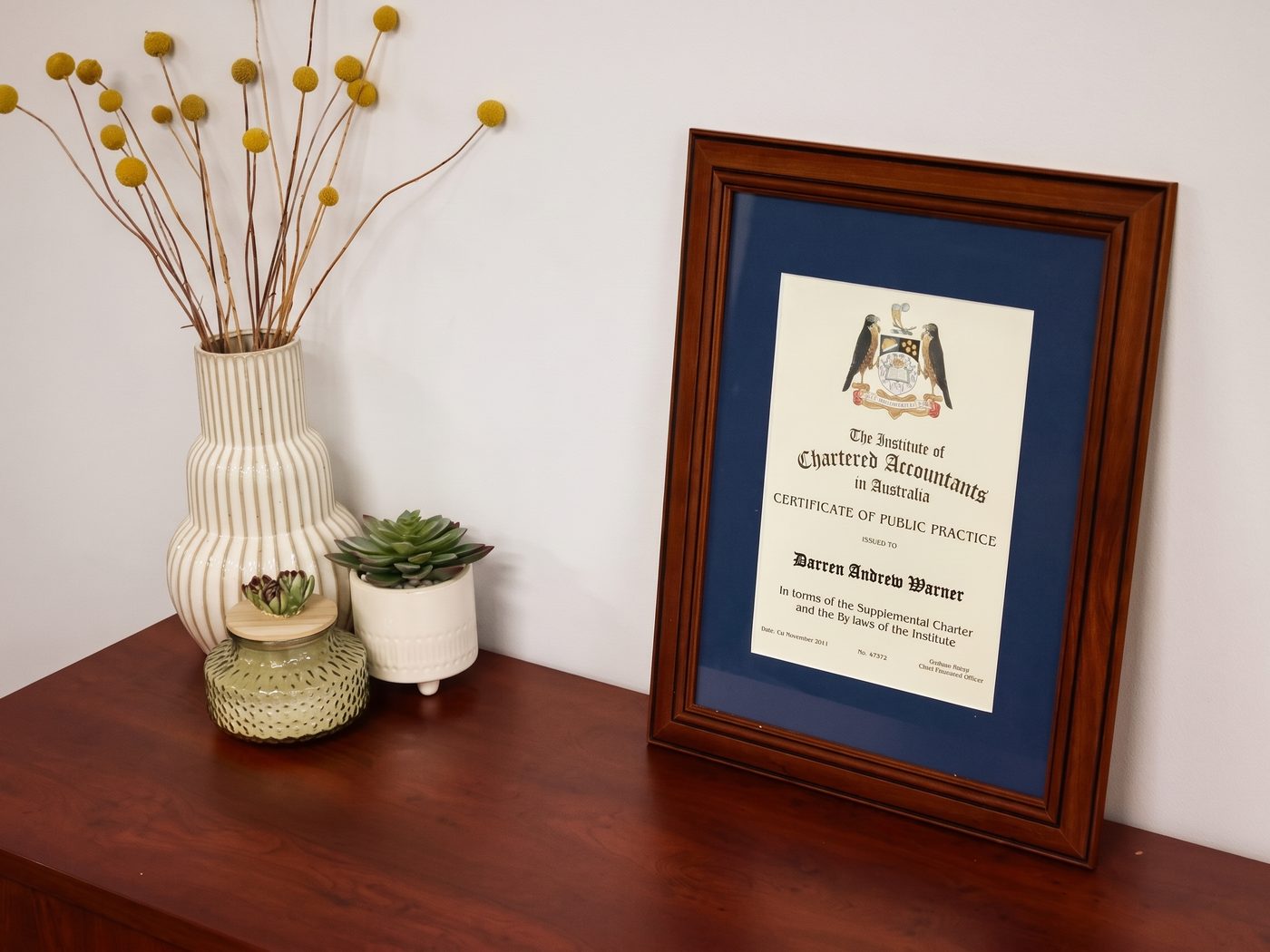
Darren Warner CA holds a Certificate of Public Practice. DWA operates under a scheme approved under Professional Standards Legislation. The person you meet is the person who does your work.
Common questions
Accountant or Chartered Accountant?
Not usually by much. You pay for the work, not the letters. Fees follow the entity, the state of your records and what is outstanding. What changes with a CA is who stands behind the work when something goes wrong.
You are not required to use one. Many small businesses do, because the year-end return is the small part. Structure, cash flow and tax planning are where the money is made or lost, and that is advice work. A CA or CPA is trained and checked for exactly that.
Only if they are registered with the Tax Practitioners Board as a tax agent. A registered BAS agent can prepare and lodge your BAS but not your income tax return. Ask for the registration number. It is public on the TPB register.
They are two designations from two bodies, CPA Australia and CA ANZ. Both need a degree, a postgraduate program, supervised experience and ongoing training. Both are a real step up from an unqualified accountant. Either one means someone is holding your accountant to account.
The person is a current member of Chartered Accountants Australia and New Zealand. They passed the CA Program, completed three years of mentored practical experience, and keep the title by doing at least 120 hours of professional development every three years.

Start with a free consultation.
Half an hour, no charge. You leave knowing what you need. The fee follows in writing.